

Genetic Prediction of Cancer Recurrence: Scientists Verify Reliability of Computer Models
In biomedical research, machine learning algorithms are often used to analyse data—for instance, to predict cancer recurrence. However, it is not always clear whether these algorithms are detecting meaningful patterns or merely fitting random noise in the data. Scientists from HSE University, IBCh RAS, and Moscow State University have developed a test that makes it possible to determine this distinction. It could become an important tool for verifying the reliability of algorithms in medicine and biology. The study has been published on arXiv.
Machine learning methods help analyse complex biological data, ie for predicting the likelihood of cancer recurrence based on gene expression, which reflects the activity levels of specific DNA regions within cells. However, it is not always clear whether these algorithms are detecting meaningful patterns or merely fitting random noise in the data.
A team of scientists from HSE University, IBCh RAS, and Moscow State University has developed a test to assess how reliably the classifier distinguishes between different patient groups. In this case, the two groups were patients who experienced a recurrence of the disease and those who did not. A model performs correctly if it effectively captures biologically meaningful differences. If the algorithm simply separates the data at random, its accuracy may appear deceptively high. The researchers focused on linear classifiers, one of the most widely used ML tools in biomedicine.

Anton Zhiyanov
'We aimed to test whether randomly generated (synthetic) data could be separated by a linear classifier as effectively as real biological samples. To do this, we calculated an upper bound on the p-value, which indicates the likelihood that the model is merely "guessing." The lower this p-value, the more reliable the classifier,' explains Anton Zhiyanov, Research Fellow at the HSE Laboratory of Molecular Physiology.
The researchers conducted a series of experiments using synthetic data, allowing them to precisely control the degree of differences between classes. They then applied the new test to real-world medical models that predict the risk of breast cancer recurrence.
The results showed that most classifiers failed to capture any meaningful differences between patients with and without recurrence. Further analysis revealed that 559 out of 570 models produced results consistent with random chance. This suggests that many algorithms may appear accurate, while in reality their predictions are driven by coincidences rather than genuine patterns.
However, the researchers also identified reliable models that reveal biologically meaningful patterns. One such model was a classifier that focused on the activity levels of the ELOVL5 and IGFBP6 genes. This algorithm was further tested on an independent data sample, confirming that differences in the expression of these genes are indeed linked to the risk of cancer recurrence.
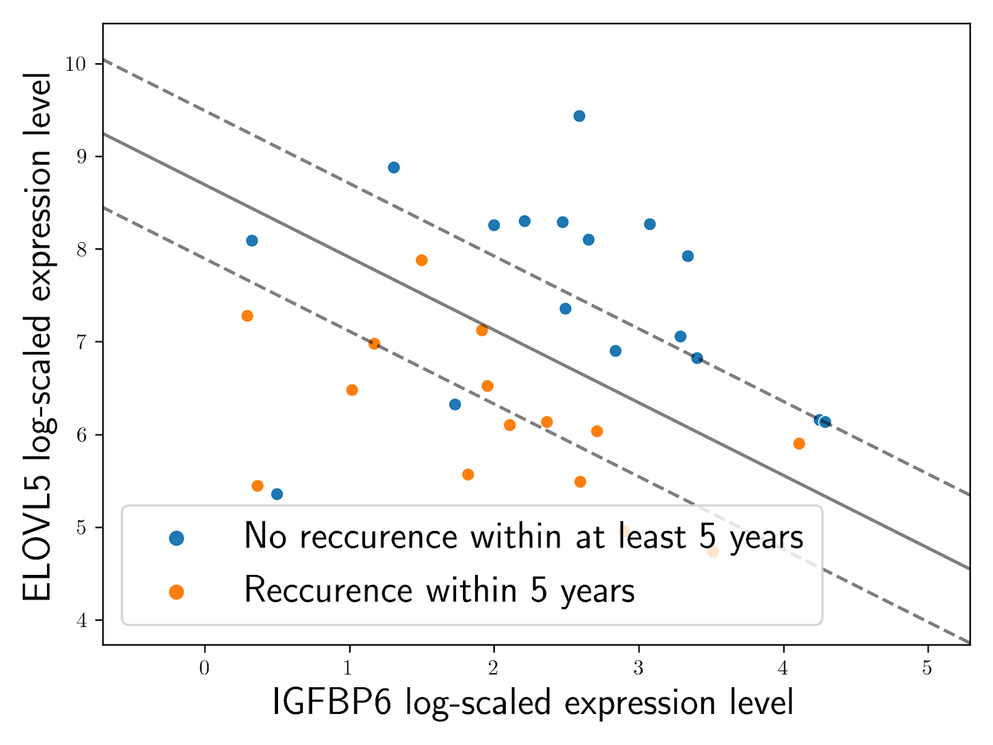
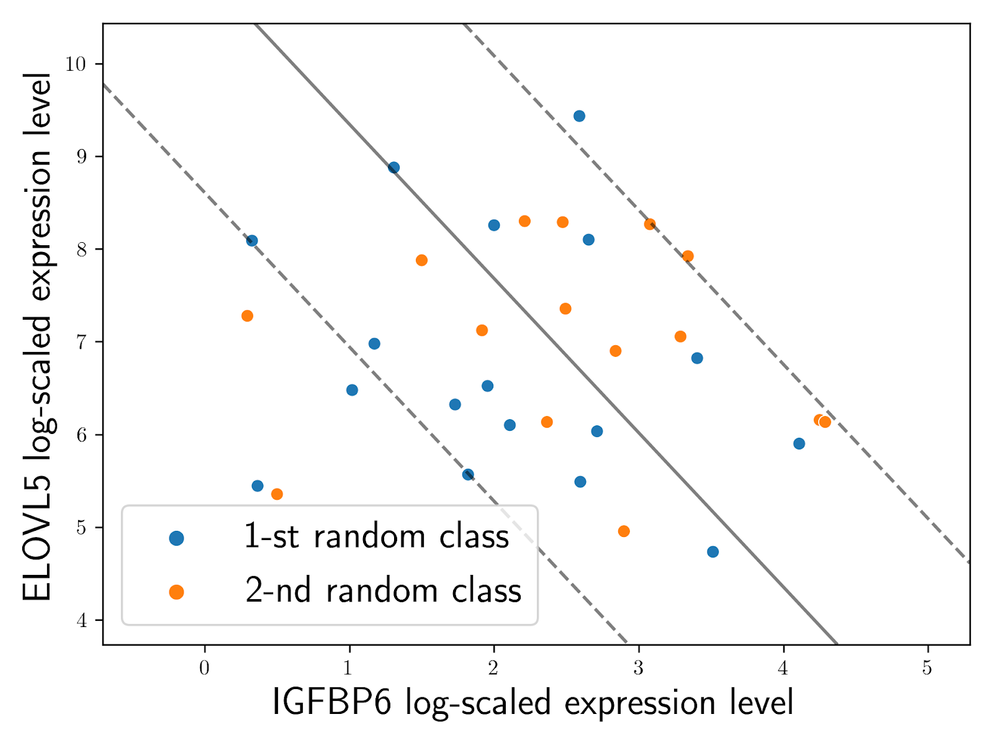
Each point on the graph represents a patient, with the expression levels of two genes measured: IGFBP6 on the X-axis and ELOVL5 on the Y-axis. The orange dots represent patients with a recurrence, while the blue dots represent those without. In the first graph, these points (patients) are clearly separated by a straight line, representing a linear classifier. In the second graph, the points are randomly distributed, and the classifier fails to identify any patterns between gene expression and actual recurrence.
Alexander Tonevitsky
'Our test could become an important tool for verifying the reliability of algorithms in biology and medicine. It helps prevent false conclusions and emphasises models that truly identify important patterns, which is crucial for making decisions about patient treatment,' comments Alexander Tonevitsky, Professor at the HSE Faculty of Biology and Biotechnology.
The study was conducted with support from HSE University's Basic Research Programme within the framework of the Centres of Excellence project.
See also:

Scientists Test Asymmetry Between Matter and Antimatter
An international team, including scientists from HSE University, has collected and analysed data from dozens of experiments on charm mixing—the process in which an unstable charm meson oscillates between its particle and antiparticle states. These oscillations were observed only four times per thousand decays, fully consistent with the predictions of the Standard Model. This indicates that no signs of new physics have yet been detected in these processes, and if unknown particles do exist, they are likely too heavy to be observed with current equipment. The paper has been published in Physical Review D.
HSE Scientists Reveal What Drives Public Trust in Science
Researchers at HSE ISSEK have analysed the level of trust in scientific knowledge in Russian society and the factors shaping attitudes and perceptions. It was found that trust in science depends more on everyday experience, social expectations, and the perceived promises of science than on objective knowledge. The article has been published in Universe of Russia.
Scientists Uncover Why Consumers Are Reluctant to Pay for Sugar-Free Products
Researchers at the HSE Institute for Cognitive Neuroscience have investigated how 'sugar-free' labelling affects consumers’ willingness to pay for such products. It was found that the label has little impact on the products’ appeal due to a trade-off between sweetness and healthiness: on the one hand, the label can deter consumers by implying an inferior taste, while on the other, it signals potential health benefits. The study findings have been published in Frontiers in Nutrition.
HSE Psycholinguists Launch Digital Tool to Spot Dyslexia in Children
Specialists from HSE University's Centre for Language and Brain have introduced LexiMetr, a new digital tool for diagnosing dyslexia in primary school students. This is the first standardised application in Russia that enables fast and reliable assessment of children’s reading skills to identify dyslexia or the risk of developing it. The application is available on the RuStore platform and runs on Android tablets.
Physicists Propose New Mechanism to Enhance Superconductivity with 'Quantum Glue'
A team of researchers, including scientists from HSE MIEM, has demonstrated that defects in a material can enhance, rather than hinder, superconductivity. This occurs through interaction between defective and cleaner regions, which creates a 'quantum glue'—a uniform component that binds distinct superconducting regions into a single network. Calculations confirm that this mechanism could aid in developing superconductors that operate at higher temperatures. The study has been published in Communications Physics.
Neural Network Trained to Predict Crises in Russian Stock Market
Economists from HSE University have developed a neural network model that can predict the onset of a short-term stock market crisis with over 83% accuracy, one day in advance. The model performs well even on complex, imbalanced data and incorporates not only economic indicators but also investor sentiment. The paper by Tamara Teplova, Maksim Fayzulin, and Aleksei Kurkin from the Centre for Financial Research and Data Analytics at the HSE Faculty of Economic Sciences has been published in Socio-Economic Planning Sciences.
Larger Groups of Students Use AI More Effectively in Learning
Researchers at the Institute of Education and the Faculty of Economic Sciences at HSE University have studied what factors determine the success of student group projects when they are completed with the help of artificial intelligence (AI). Their findings suggest that, in addition to the knowledge level of the team members, the size of the group also plays a significant role—the larger it is, the more efficient the process becomes. The study was published in Innovations in Education and Teaching International.
New Models for Studying Diseases: From Petri Dishes to Organs-on-a-Chip
Biologists from HSE University, in collaboration with researchers from the Kulakov National Medical Research Centre for Obstetrics, Gynecology, and Perinatology, have used advanced microfluidic technologies to study preeclampsia—one of the most dangerous pregnancy complications, posing serious risks to the life and health of both mother and child. In a paper published in BioChip Journal, the researchers review modern cellular models—including advanced placenta-on-a-chip technologies—that offer deeper insights into the mechanisms of the disorder and support the development of effective treatments.
Using Two Cryptocurrencies Enhances Volatility Forecasting
Researchers from the HSE Faculty of Economic Sciences have found that Bitcoin price volatility can be effectively predicted using Ethereum, the second-most popular cryptocurrency. Incorporating Ethereum into a predictive model reduces the forecast error to 23%, outperforming neural networks and other complex algorithms. The article has been published in Applied Econometrics.
Administrative Staff Are Crucial to University Efficiency—But Only in Teaching-Oriented Institutions
An international team of researchers, including scholars from HSE University, has analysed how the number of non-academic staff affects a university’s performance. The study found that the outcome depends on the institution’s profile: in research universities, the share of administrative and support staff has no effect on efficiency, whereas in teaching-oriented universities, there is a positive correlation. The findings have been published in Applied Economics.