

Winners of the International Olympiad in Artificial Intelligence Admitted to HSE University
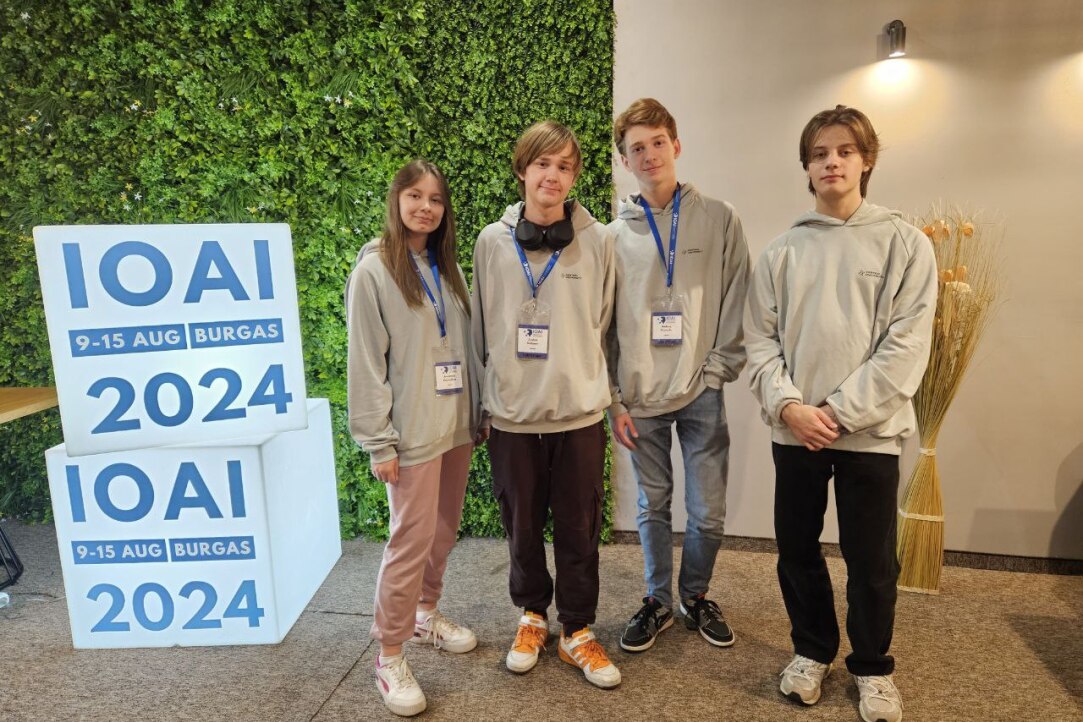
In mid-August, Bulgaria hosted the finals of the first International Olympiad in Artificial Intelligence (IOAI) among high school students. The Russian team demonstrated excellent results, winning gold medals in the scientific round, silver medals in the practical round, and coming first in both rounds overall. This year two members of the Russian team were accepted into the programmes of the HSE Faculty of Computer Science.
In the final round of the competition, the Russian team faced off against school students from 39 countries, including China, Japan, Canada, Sweden, the Netherlands, and the USA. The Central University (CU), established with the support of T-Bank, was responsible for training the team.
Currently, two members of the Russian team, Nikita Kurlaev and Andrey Gritsaev, are first-year students at HSE University. They talked to HSE News Service about the Olympiad, the admission process, and their plans for the future.

Nikita Kurlaev
About the Olympiad
— The fact that this year’s Olympiad was the first of its kind greatly influenced our experience of participating in it. It differs from traditional international Olympiads like IMO and IOI, which have a large international community and a long history of training participants. We went to the competition without knowing what tasks we would face, who the other participants would be, or how the results would be checked, etc. We prepared using official materials, but clearly it wasn’t enough.
Many teams that did not win medals included participants or candidates for the IOI and IMO national teams. These are extremely smart people who, unfortunately, did not dedicate enough time to studying the features of ML. I am sure that next year it will be even more challenging but also more interesting to participate in this Olympiad.
I am pleased to have taken first place, although it was a difficult achievement. We have been diligently preparing for a long time and we have benefited from years of experience in Olympiads, including the All-Russian Olympiad for schoolchildren, as well as our knowledge of mathematics and computer science.
About machine learning
— I've been interested in machine learning for a long time, but I didn't acquire the skills I needed to study it until the 10th grade. Even a basic understanding of ML methods requires a good knowledge of mathematics at a level beyond the school curriculum. At first, ML seemed like magic to me, and I tried unsuccessfully to play around with existing models. It wasn’t until grades 10–11 that I started to study machine learning more seriously. I read articles and books about ML, worked on small projects.
About HSE University
— I have realised that HSE University meets my requirements much better than other universities. This decision was based on several factors, including university values, campus infrastructure, teaching staff, and study process. I am confident that the ‘Applied Mathematics and Information Science’ programme at FCS offers the best bachelor's programme in computer science in Russia.
About my future plans
— In the next four years, my main focus will be on completing my degree. I may participate in student competitions or internships, but studying remains my top priority. After graduating, I hope to pursue a master’s degree in a related field. I envision myself engaging in scientific research and perhaps working in the ML field. While it’s difficult to predict what my interests will be in a few years, at the moment, I can only speak about my current interests, hoping they will remain relevant in the future.

Andrey Gritsaev
About the Olympiad
— I wanted to participate in the Olympiad for several reasons. Firstly, it was an opportunity to compete and solve problems in a field that I’m interested in. Secondly, I wanted to meet smart students from other countries who shared my passion for AI. The Olympiad consisted of two rounds: a scientific round and a practical round. In the scientific round, we were given problems that simulated real research in AI. These problems were divided into three categories: machine learning, natural language processing, and computer vision. During the practical round, we conducted experiments with AI software, such as ChatGPT and DALL-E 2.
Tips for high school students
— Consider participating in the All-Russian Olympiad in Artificial Intelligence if you are interested in this field. Additionally, if you want to learn more about machine learning, I suggest taking some courses. This year, there may be training camps preparing for AI Olympiads, so it's worth keeping an eye out for updates from the Olympiad community.
About my future plans
— In the next few years, I intend to pursue research and work in this area.
See also:

Final of International Yandex–HSE Olympiad in AI and Data Analysis Held at HSE University
Yandex Education and the HSE Faculty of Computer Science have announced the results of the international AIDAO (Artificial Intelligence and Data Analysis Olympiad) competition. Students from 14 countries took part. For the second year in a row, first place went to the team AI Capybara, which developed the most accurate AI model for an autonomous vehicle vision system.
AI Lingua Included in Compilation of Best International AI Practices in Higher Education
HSE University has been acknowledged internationally for its pioneering efforts in integrating artificial intelligence into higher education. The AI Lingua Neural Network developed at HSE was included in the renowned international collection ‘The Global Development of AI-Empowered Higher Education: Beyond the Horizon.’ The compilation was prepared by the Institute of Education (IOE) of Tsinghua University with the support of the Ministry of Education of the People's Republic of China and a global advisory committee, which included experts from Oxford, UCL, Sorbonne, Stanford, and other leading academic centres.
Technological Breakthrough: Research by AI and Digital Science Institute Recognised at AI Journey 2025
Researchers from the AI and Digital Science Institute (part of the HSE Faculty of Computer Science) presented cutting-edge AI studies, noted for their scientific novelty and practical relevance, at the AI Journey 2025 International Conference. A research project by Maxim Rakhuba, Head of the Laboratory for Matrix and Tensor Methods in Machine Learning, received the AI Leaders 2025 award. Aibek Alanov, Head of the Centre of Deep Learning and Bayesian Methods, was among the finalists.
HSE University to Join Physical AI Garage Project by Yandex
Yandex is collaborating with leading Russian universities to launch a new educational programme called Physical AI Garage. This initiative unites five universities—HSE University, ITMO, MIPT, MAI, and MEPhI—to train future professionals in physical artificial intelligence by tackling real-world industrial challenges. The programme is free, and participants will receive scholarships.
Larger Groups of Students Use AI More Effectively in Learning
Researchers at the Institute of Education and the Faculty of Economic Sciences at HSE University have studied what factors determine the success of student group projects when they are completed with the help of artificial intelligence (AI). Their findings suggest that, in addition to the knowledge level of the team members, the size of the group also plays a significant role—the larger it is, the more efficient the process becomes. The study was published in Innovations in Education and Teaching International.
HSE Researchers Assess Creative Industry Losses from Use of GenAI
Speaking at the IPQuorum.Music forum on October 15, Leonid Gokhberg, HSE First Vice Rector, and Daniil Kudrin, an expert at the Centre for Industry and Corporate Projects of HSE ISSEK, presented the findings of the first study in Russia on the economic impact of GenAI on creative professions. The analysis shows that creators’ potential losses could reach one trillion roubles by 2030.
‘Fall into ML Has Firmly Established Itself as a Landmark Event in Russia’s AI Scene’
On October 24–25, 2025, the AI and Digital Science Institute of the HSE Faculty of Computer Science will host the fourth annual Fall into ML 2025 conference at the HSE Cultural Centre. The event is once again supported by its general partner, Sber. The focus this year is on breakthrough research and the future of fundamental AI.
Critique of Obscure Reason: Artificial Intelligence in the Perception of Mathematicians
Mathematicians at HSE University believe that there is no need to fear losing jobs because of the widespread use of AI, while at the same time they warn against uncritical acceptance of works and projects prepared with its help. AI, however, can be a useful tool in research, creating models and processing large volumes of information.
Registration for Russian Olympiad in Artificial Intelligence 2025 Now Open
Registration for the fifth season of the Russian Olympiad in Artificial Intelligence has opened. This year, the competition has gained international status. The event is open to students in the 8–11 grades both in Russia and abroad. The winners will receive benefits when applying to Russian universities.
Global AI Trends Discussed at International Foresight Workshop at HSE University
At an international foresight workshop on artificial intelligence held at HSE University, Russian and foreign scholars discussed the trends and challenges arising from the rapid development of AI.