

HSE University and University of Campinas Join Forces to Build Alternative Financial System
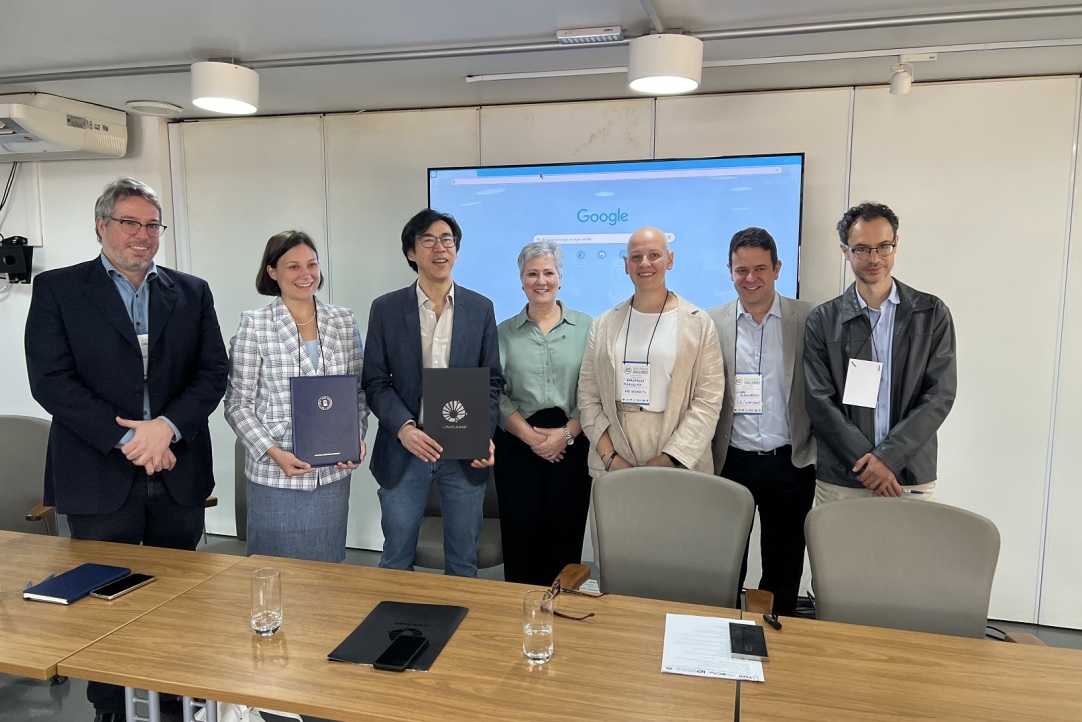
HSE University and the University of Campinas (UNICAMP, Brazil) have announced the launch of a major joint research project to develop new approaches to an alternative international financial system. The initiative, which brings together leading experts in global economics and finance, seeks to analyse the current state of international financial architecture and explore ways of transforming it in the context of a changing geopolitical landscape.
The project was officially launched during the first joint winter school of HSE University, UNICAMP, and Durban University of Technology (DUT), held in Campinas on August 25–26, 2025. The start of the project was announced by Alexandra Morozkina, Deputy Dean for Research at the HSE Faculty of World Economy and International Affairs (WEIA), and Célio Hiratuka, Director of the Institute of Economics at UNICAMP.
According to Alexandra Morozkina, the overlap in the universities’ research interests in the field of economic blocs has helped to build long-term friendly relations. The researchers plan to focus on the study of international financial flows in BRICS countries and the possibilities for expanding settlements in national currencies.

The project envisages active involvement of both universities’ students and postgraduates. The partnership will entail joint research projects, academic articles, conferences, and seminars.
Students from HSE University’s Faculty of World Economy and International Affairs and the University of Campinas presented projects for future joint publications at the postgraduate forum of the BRICS conference. For example, Alina Semenova, a Master’s student in the World Economy programme, and Alisson Oliveira de Souza Carvalho, a postgraduate student at the Institute of Economics, announced their forthcoming paper ‘National Payment Systems Under Pressure: Lessons from Russia and Brazil for the Development of BRICS Pay’—a strategic analysis of building sovereign payment infrastructure in a multipolar world. The analysis is based on an exchange of Russian and Brazilian experience in establishing national payment systems.
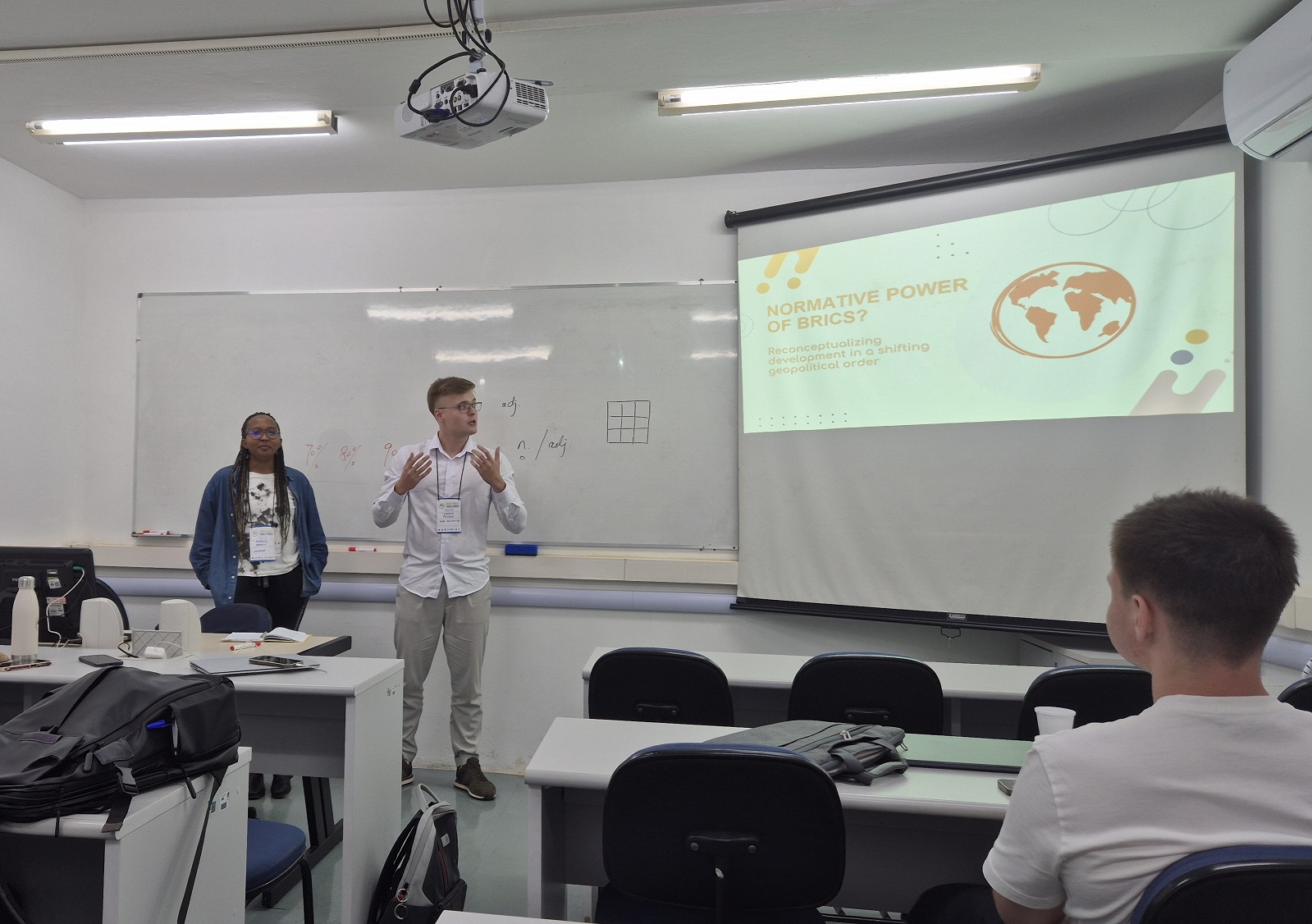
Timofey Petrov, a third-year student on HSE University’s International Relations and Global Studies programme, and Vanessa Nakedi, a student at the University of Campinas Institute of Economics, presented a draft paper entitled ‘Normative Power of BRICS: Reconceptualising Development in a Shifting Geopolitical Order.’ The article examines the role of BRICS in reshaping the global narrative of international economic assistance. It assesses the bloc’s effectiveness as a counterbalance to entrenched aid practices that prioritise donors’ geostrategic interests at the expense of recipients’ sovereignty and sustainable development.
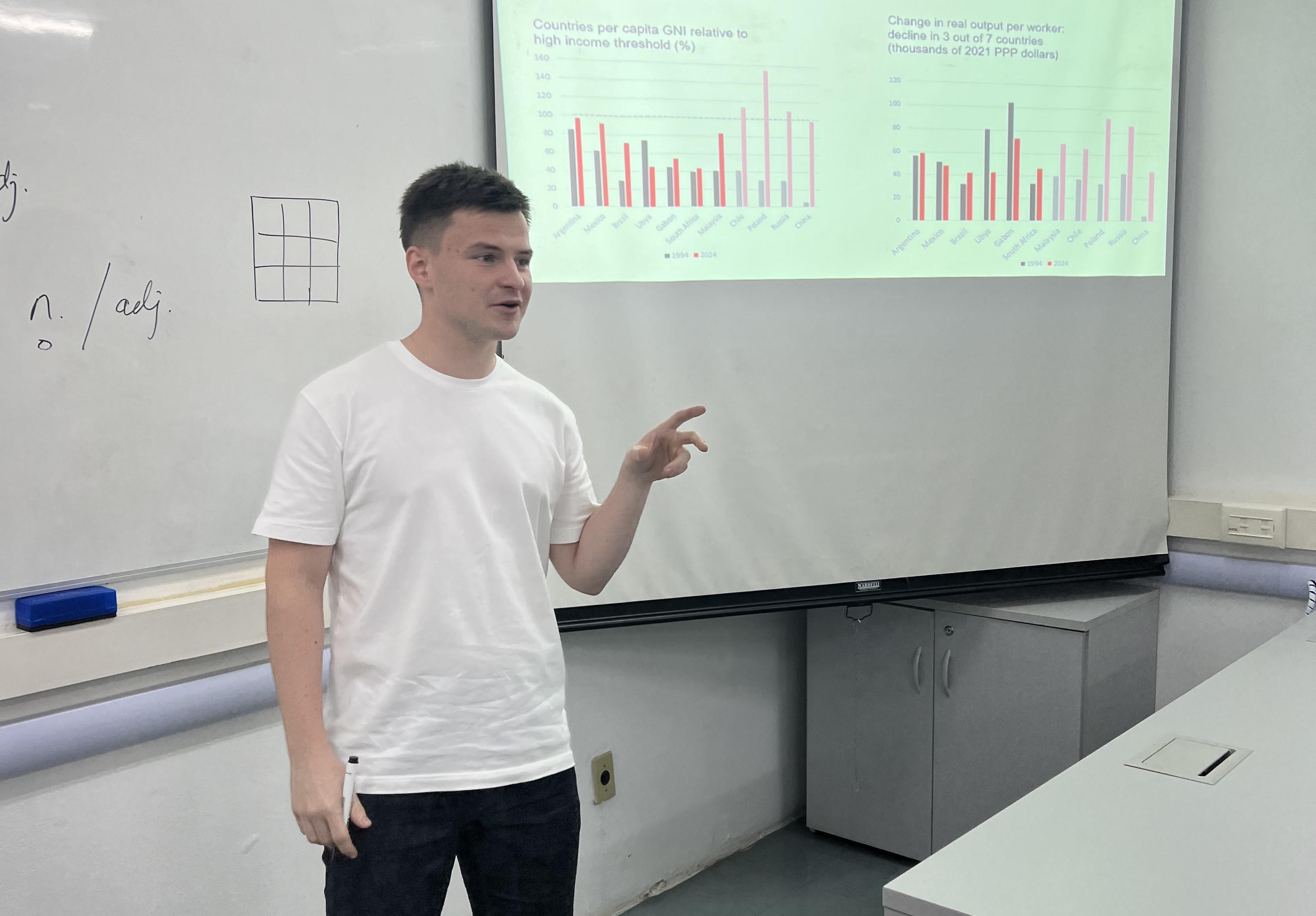
Kirill Lysenko, a PhD student on HSE University’s Economics programme, and João Guilherme Marques Augusto Monteiro, a PhD student at UNICAMP, proposed an analysis of the ‘middle-income trap.’ In their work, the doctoral students plan to examine a broad range of issues underlying slow progress in national development—from inefficient income redistribution systems to resource dependence and low investment in research and development.

Fyodor Alekseev, Junior Research Fellow at HSE University’s Laboratory for Economics of Climate Change, together with Flávio Vinius Ferreira, a student at the University of Campinas Institute of Economics, presented a draft paper entitled ‘Green Industrial Policies and Regional Climate Cooperation: Insights from Brazil and Beyond.’ The article aims to explore the extent to which green industrial policies in Brazil, Chile, and Mexico create the foundations for regional climate cooperation in Latin America.
The HSE University WEIA delegation took an active part in the school’s programme, which included lectures and discussions. Alexandra Morozkina and Anastasia Podrugina, Associate Professor at HSE’s School of World Economy, delivered a lecture entitled ‘Feel the Fear and Do It Anyway: Approaches to an Alternative Financial System,’ presenting an analysis of the dominance of the dollar in the global financial system and the prospects for expanding settlements in national currencies, including within BRICS. Professor Igor Makarov, Head of HSE’s School of World Economy, gave a talk ‘Towards a New Sustainable Development Agenda Beyond 2030,’ in which he highlighted the need to transform the current model of economic development and underlined the key role of BRICS countries in shaping new approaches.
Participation in the winter school at the University of Campinas marked an important step for HSE in strengthening international partnerships, expanding academic exchange, and preparing a new generation of researchers ready to address complex challenges in international finance and sustainable development.

See also:

‘Hedgehog’ Versus ‘Relatives’: Researchers Measure How the Brain Responds to Unexpected Words During Natural Speech
Russian neurophysiologists, including researchers from HSE University, have demonstrated the feasibility of using event-related fields (ERFs) to study brain activity during natural speech perception. The researchers showed that this approach can be applied not only to individual words but also to continuous speech. Their findings indicate that words whose meanings differ significantly from the preceding context require longer processing times. The study also reveals that the brain processes function words in two stages: first, it identifies their grammatical role and then uses this information to predict the next word. The study has been published in Frontiers in Human Neuroscience.
HSE Graduate School of Business and Alfa-Bank Hold Summer School for Students from China
Twenty-seven students from Chinese universities took part in the international summer school ‘Digital Product Management’ organised by the HSE Graduate School of Business and Alfa-Bank. Over the course of a week, participants explored the Russian economy and business environment, learned about current technology trends, and worked through the key stages of digital product development step by step—from researching user needs and defining a problem to developing a prototype and presenting their final project.
Physicists Discover What Happens Inside a Stable Vortex
Large vortices with characteristic spiral arms are often observed in the atmosphere and the ocean. Physicists from HSE University have explained how these structures form and why they retain their shape. The researchers found that velocities at points located along the same vortex arc remain correlated even over long distances. At the same time, this correlation weakens rapidly with increasing distance from the vortex centre. These differences help explain the formation of spiral arms and may improve models of atmospheric and oceanic currents. The findings have been published in Physical Review Fluids.
‘The Peak of Stupidity’ and ‘The Valley of Despair’: HSE Economists Propose an Explanation for the Dunning–Kruger Effect
The Dunning–Kruger effect, which describes a sharp surge in self-confidence among beginners followed by an equally rapid decline as they gain experience, can be explained by the nature of the learning process and the acquisition of new knowledge. This conclusion was reached by Andrey Vorchik of the HSE Faculty of Economic Sciences together with independent researcher Murat Mamyshev. They developed a mathematical model of learning and demonstrated how subjective confidence is formed and changes as knowledge accumulates, as well as how teachers can reduce the ‘valley of despair’ experienced by learners.
‘Beyond Developing a Powerful Skill Set, ICEF Also Helped Build My Resilience’
Umarkhon Isaev, from Tashkent, Uzbekistan, graduated from the International Bachelor's Programme in Economics and Finance at ICEF HSE in 2026. In this interview, Umarkhon talks about what made ICEF the ideal place to pursue his interest in finance, how his programme challenged him in ways he had never experienced before, and why it’s important to find friends who have your back when times are tough.
Advancing Collaboration: HSE Faculty of Computer Science and Harbin Institute of Technology Hold Joint Seminar
From July 13 to 16, 2026, the Faculty of Computer Science hosted the Russian–Sino Research Seminar on Machine Learning Applications, organised by the HSE Laboratory for Cloud and Mobile Technologies in partnership with the Harbin Institute of Technology (China). A delegation comprising seven students and three university representatives travelled to Moscow to take part in an intensive four-day programme.
HSE and Karakalpak State University Agree on Cooperation
HSE University and Berdakh Karakalpak State University have signed a cooperation agreement to strengthen collaboration in research, education, and innovation. Through the expertise of its Сentre of Digital Technologies for Nature-Based Solutions of the Carbon Measurement Supersites Programme, HSE University will work with colleagues from Uzbekistan to assess climate risks and evaluate opportunities for implementing nature-based climate projects in the region. The partners also plan to develop joint research and educational programmes.
‘We Are Always Open to Collaboration, and China Is One of Our Most Important Partners’
From July 20 to 27, 2026, the HSE Faculty of Urban and Regional Development (FURD) is hosting a summer school for students from Tianjin University dedicated to the preservation of cultural heritage. Throughout the week, participants have attended lectures, practical workshops, and field visits to some of Moscow’s most iconic heritage sites. The summer school is the faculty’s first international programme of this kind and forms part of the expanding educational cooperation between Russia and China.
Physicists at HSE University and FIAN Discover Way to 'Photograph' Sound for Testing Materials Used in 6G Communications
Researchers at HSE University, in collaboration with colleagues from the Lebedev Physical Institute of the Russian Academy of Sciences (FIAN), have developed a method for rapidly determining how firmly a film is bonded to a substrate. This is important for the creation of ultrahigh-frequency acoustic filters, which are key components of next-generation 5G and 6G communications. For the first time, researchers have succeeded in measuring the lateral rigidity of the bond between a two-dimensional material film and a substrate in this way. The study results have been published in Applied Physics Letters.
HSE University and Peking University Expand Their Partnership
Peking University President Gao Song paid his first visit to HSE University as part of his first overseas trip since taking office in May 2026. The main purpose of the talks was to consolidate existing areas of cooperation and expand joint projects between HSE University and Peking University within the framework of the Cross Years of Russia–China Cooperation in Education (2026–2027).