

HSE University Presents Smart Orthosis at Hope for Technology Forum
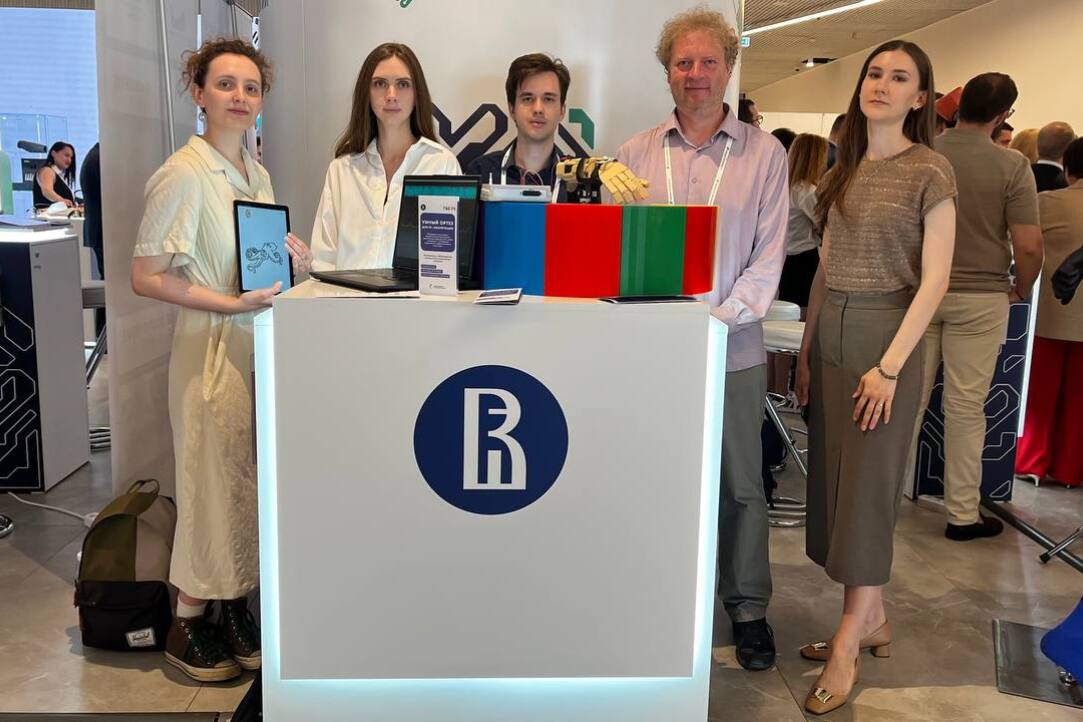
On July 10–11, 2025, Moscow hosted the 10th Hope for Technology National Forum of the Rehabilitation Industry and Universal Design. The event was aimed at discussing innovative achievements in the rehabilitation industry. The MIEM Student Design Bureau and the HSE Institute for Cognitive Neuroscience presented a smart orthosis, which was developed at the request of orthopedists.
The Smart Orthosis project is a comprehensive rehabilitation system geared towards helping in the development of motor activity in patients (primarily children) who experience difficulty bending their arm at the elbow joint. The system operates on the basis of an electromyographic signal (EMG). The developers guarantee an individual approach with automatic personal adjustment to the individual characteristics of the patient. This development solves several rehabilitation problems at once: it increases the effectiveness of surgical intervention, reduces dependence on third parties (psychologists, parents) in existing rehabilitation programmes, and improves the ability to monitor the recovery process.
Evgeny Blagoveshchensky, Leading Research Fellow at the Centre for Cognition & Decision Making of the Institute for Cognitive Neuroscience, notes that the idea to develop an orthosis arose following the request of orthopedists as a result of cooperation between HSE University and the G. Turner National Medical Research Center for Pediatric Orthopedics and Trauma Surgery of the Ministry of Health of the Russian Federation. ‘In Russia, rehabilitation processes are often standardised, and personal programmes are an exception. Initially, we tried to find ready-made solutions, but they were unavailable even on the global market. This prompted us to create our own solution. Thanks to specialists from the MIEM Design Bureau, we managed to create the first prototype, which was presented at the exhibition. It is an exoskeleton with assistive functions that can adapt to the patient's needs. We hope to put it into production soon,’ adds Blagoveshchensky.
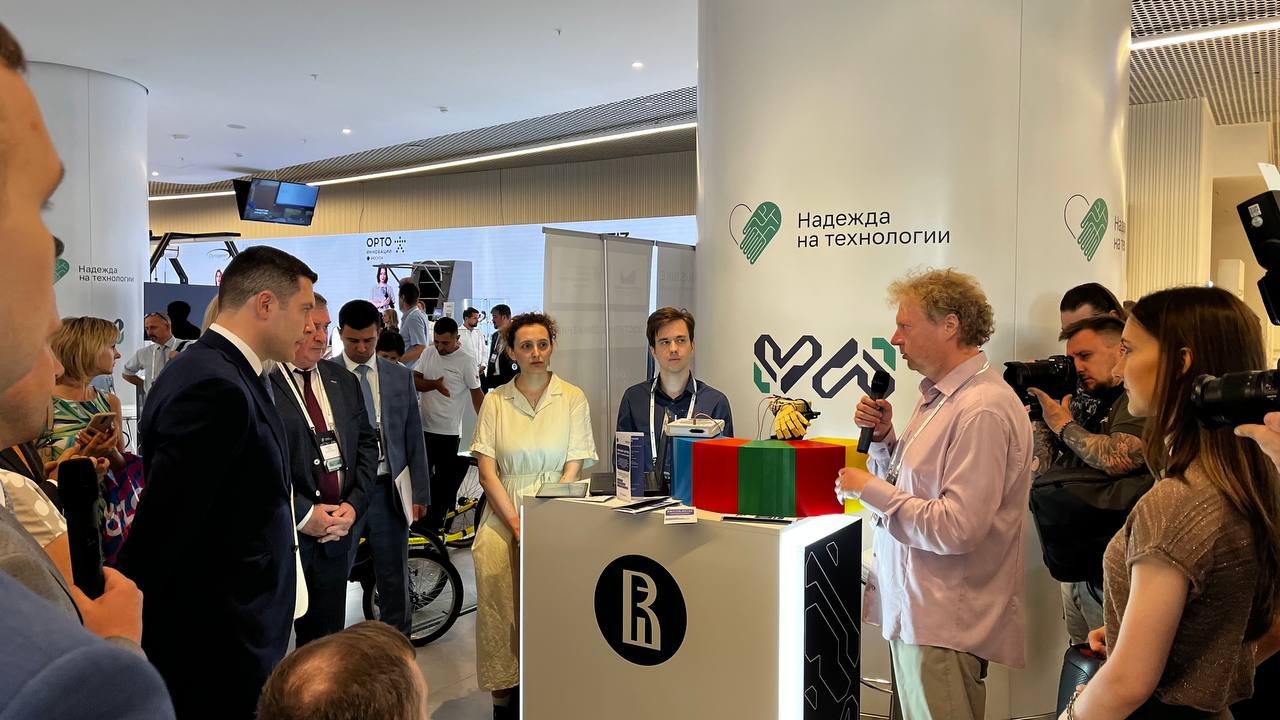
The orthosis consists of a mechanical exoskeleton, software, a biofeedback system, a digital gaming platform, and myography sensors. The intelligent system will analyse the patient's movements and adjust to them, providing fixation in the hand and biceps area and precise movement control.
The project was well received by forum guests and Minister of Industry and Trade Anton Alikhanov, who expressed interest in the implementation of the product and its potential for further application in daily practice.

Dmitry Kovalenko
Dmitry Kovalenko, HSE University Vice Rector and Director of HSE MIEM, says that the renewed Student Design Bureau at MIEM is intended to become an innovative hub for supporting student design developments aimed at further widespread implementation. ‘This means comprehensive organisational, methodological and substantive support, as well as the development of optimal models for the institute's interaction with partner companies and customers. The smart orthosis is the first step, a kind of pilot project. It’s great that it was highly praised by experts in science and the real sector,’ he adds.
During the forum, specialists from the MIEM Student Design Bureau and the HSE Institute for Cognitive Neuroscience held talks with representatives of potential partner companies of the project.

Ilya Ivanov
Ilya Ivanov, Leading Research Fellow at the School of Electronic Engineering of the HSE Tikhonov Moscow Institute of Electronics and Mathematics and Head of the MIEM Design Bureau, comments: ‘We consider healthcare to be one of our current priorities. It’s a huge field for the application of AI technologies. Our students are happy to participate in such projects, both because there are many truly non-trivial and creative tasks, and because these tasks are aimed at achieving perhaps the most worthwhile goals—preserving human health and helping with rehabilitation.’
Veronika Prokhorova
Veronika Prokhorova, MIEM's Deputy Director for Project Work, notes that the MIEM Design Bureau, where students implement technological product projects, has already established fruitful partnerships with large manufacturers of various modern equipment, as well as among leading HSE departments. ‘We value these partnerships and hope to present other developments of the design bureau in the near future,’ adds Prokhorova.
For more news about the activity of the HSE MIEM Design Bureau, please see the official Telegram channel (in Russian).
About the Hope for Technology Forum
The forum was held on July 11–12 in Moscow at the Lomonosov Cluster of the Moscow State University Innovation Centre. The participants, including leading experts in the field of healthcare, rehabilitation technologies, representatives of ministries, government agencies, and large equipment manufacturers, had an opportunity to learn more about advanced developments and integrated solutions aimed at creating a barrier-free environment, as well as the latest technological solutions designed to make life easier for people with disabilities and limited mobility.

See also:

HSE Researchers Create Genome-Wide Map of Quadruplexes
An international team, including researchers from HSE University, has created the first comprehensive map of quadruplexes—unstable DNA structures involved in gene regulation. For the first time, scientists have shown that these structures function in pairs: one is located in a DNA region that initiates gene transcription, while the other lies in a nearby region that enhances this process. In healthy tissues, quadruplexes regulate tissue-specific genes, whereas in cancerous tissues they influence genes responsible for cell growth and division. These findings may contribute to the development of new anticancer drugs that target quadruplexes. The study has been published in Nucleic Acids Research.
Mathematician from HSE University–Nizhny Novgorod Solves Equation Considered Unsolvable in Quadratures Since 19th Century
Mathematician Ivan Remizov from HSE University–Nizhny Novgorod and the Institute for Information Transmission Problems of the Russian Academy of Sciences has made a conceptual breakthrough in the theory of differential equations. He has derived a universal formula for solving problems that had been considered unsolvable in quadratures for more than 190 years. This result fundamentally reshapes one of the oldest areas of mathematics and has potential to have important implications for fundamental physics and economics. The paper has been published in Vladikavkaz Mathematical Journal.
HSE AI Research Centre Simplifies Particle Physics Experiments
Scientists at the HSE AI Research Centre have developed a novel approach to determining robustness in deep learning models. Their method works eight times faster than an exhaustive model search and significantly reduces the need for manual verification. It can be applied to particle physics problems using neural networks of various architectures. The study has been published in IEEE Access.
Scientists Show That Peer Influence Can Be as Effective as Expert Advice
Eating habits can be shaped not only by the authority of medical experts but also through ordinary conversations among friends. Researchers at HSE University have shown that advice from peers to reduce sugar consumption is just as effective as advice from experts. The study's findings have been published in Frontiers in Nutrition.
HSE University Establishes Cybersecurity Department
The HSE University Moscow Tikhonov Institute of Electronics and Mathematics (MIEM) has established a new Department of Cybersecurity. This move consolidates MIEM’s educational, scientific, and expert resources in information and computer security, expands its portfolio of educational programmes, strengthens partnerships with industry leaders, and enhances HSE’s position as a leading centre of cybersecurity competence.
HSE University to Host Second ‘Genetics and the Heart’ Congress
HSE University, the National Research League of Cardiac Genetics, and the Central State Medical Academy of the Administrative Directorate of the President will hold the Second ‘Genetics and the Heart’ Congress with international participation. The event will take place on February 7–8, 2026, at the HSE University Cultural Centre.
HSE University Develops Tool for Assessing Text Complexity in Low-Resource Languages
Researchers at the HSE Centre for Language and Brain have developed a tool for assessing text complexity in low-resource languages. The first version supports several of Russia’s minority languages, including Adyghe, Bashkir, Buryat, Tatar, Ossetian, and Udmurt. This is the first tool of its kind designed specifically for these languages, taking into account their unique morphological and lexical features.
HSE Scientists Uncover How Authoritativeness Shapes Trust
Researchers at the HSE Institute for Cognitive Neuroscience have studied how the brain responds to audio deepfakes—realistic fake speech recordings created using AI. The study shows that people tend to trust the current opinion of an authoritative speaker even when new statements contradict the speaker’s previous position. This effect also occurs when the statement conflicts with the listener’s internal attitudes. The research has been published in the journal NeuroImage.
Language Mapping in the Operating Room: HSE Neurolinguists Assist Surgeons in Complex Brain Surgery
Researchers from the HSE Center for Language and Brain took part in brain surgery on a patient who had been seriously wounded in the SMO. A shell fragment approximately five centimetres long entered through the eye socket, penetrated the cranial cavity, and became lodged in the brain, piercing the temporal lobe responsible for language. Surgeons at the Burdenko Main Military Clinical Hospital removed the foreign object while the patient remained conscious. During the operation, neurolinguists conducted language tests to ensure that language function was preserved.
HSE MIEM and AlphaCHIP Innovation Centre Sign Cooperation Agreement
The key objectives of the partnership include joint projects in microelectronics and the involvement of company specialists in supervising the research activities of undergraduate and postgraduate students. Plans also focus on the preparation of joint academic publications, the organisation of industrial placements and student internships, and professional development programmes for the company’s specialists.